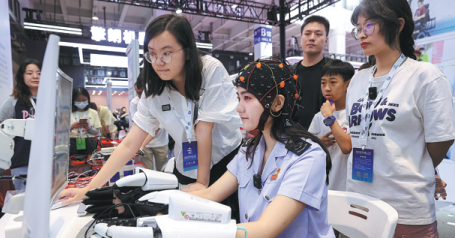
A woman tests a multimodal brain-computer interface system at the 2023 World Robot Conference in Beijing. The capital is at the national forefront of BCI.
As artificial intelligence becomes the vital sector where worldwide technology powerhouses are vying for dominance, Beijing is well-positioned to compete for leadership in the innovation of AI-enabled scenarios.
At the Beijing Economic-Technological Development Area, also known as Beijing E-Town, AI-backed business formats and scenarios — such as automated driving, AI-assisted medical diagnosis and treatment, and intelligent warehousing — continue to emerge.
"If performing surgery could be likened to driving a car, we hope to use AI technology to provide doctors with auxiliary tools, and through human-machine collaboration, to achieve 'autonomous driving' in complex surgeries," said Qin Lan, founder and chairwoman of Union Strong Tech, a tech company focusing on applying AI technology to surgical treatment.
Through digital empowerment, the company has developed a series of product solutions, assisting doctors in preoperative diagnosis, planning and critical surgical steps, promoting the standardization of interventional surgeries and the upgrade of surgical treatment methods, she said.
In e-commerce company JD, there is a group of robots busy among the shelves without a human worker in sight at an intelligent warehouse, which covers tens of thousands of square meters.
"Based on AI, we can achieve accurate projections of orders placed via our platform for certain areas, so we are primed to better prepare the inventory. The accuracy is approximately 92 percent and the predictive technology is entirely developed by our company itself," said a JD executive.
Beijing's strengths in AI research and industries are a driving force behind the dynamic business scene.
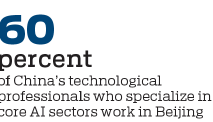
The city is home to more than 40,000 technological professionals specializing in core AI sectors, accounting for 60 percent of the country's total. Nine universities in Beijing have opened AI institutes or research centers, accounting for one-fifth of such school-led institutions nationwide, Xinhua News Agency reported.
Ranking at the forefront in terms of comprehensive AI industry strength globally, Beijing has established six key national AI laboratories, as well as three national engineering research centers. These focus on video and visual technology, deep learning technology and their applications, forming a top-tier research base integrating basic research, talent cultivation and high-level academic exchanges.
"Beijing has not only a complete industrial layout but a well-established innovation ecosystem integrating industry, academia and research," Li Kaifu, chairman and CEO of Sinovation Ventures, told Xinhua. "It has a rich pool of talent, strong (research and industry) atmosphere and multiparty support — all this has effectively advanced collaborative innovation in the field of AI."