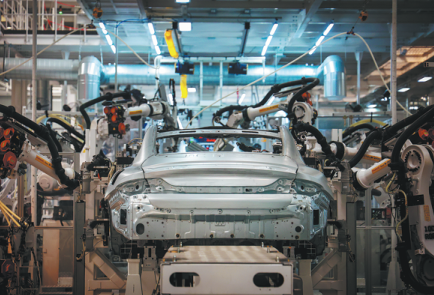
Robots assemble a Xiaomi vehicle on the production line in Beijing.
Beijing plans to expand its High-Level Autonomous Driving Demonstration Zone to 600 square kilometers, or nearly 4 percent of the city's total area, in June, according to a senior official.
Yin Yong, mayor of the city, revealed the plans to provide a greater testing ground for the integration of automated driving into smart city construction at a recent news conference on the city's high-quality development.
"New energy vehicles and automated driving are two key driving forces for smart transportation and they have the potential to profoundly change people's ways of travel and the governance of cities," Yin said.
Research shows that while the technology concerning single vehicle autonomous driving is developing rapidly, related costs still remain high. To achieve commercially viable and reliable applications, there is still a way to go, he noted.
"At the same time, it seems that currently there is no apparent connection between the intelligence of single vehicles and the intelligent development of our cities," he said. "Therefore, three years ago, Beijing took the lead in adopting the vehicle-infrastructure cooperative technology route to promote autonomous driving technology."
Back in 2020, Beijing began construction of the High-Level Autonomous Driving Demonstration Zone at the Beijing Economic-Technological Development Area, also known as Beijing E-Town, in the city's Daxing district. Since then, the zone has expanded from an initial area of 60 km to 160 sq km and is projected to reach 600 sq km in June, incorporating parts of Tongzhou and Shunyi districts on the outskirts of Beijing.
To date, more than 800 intelligent vehicles have driven in the zone and road test plates have been issued to 29 testing vehicle enterprises. The cumulative test mileage for autonomous driving in the zone is close to 30 million km.
At the High-Level Autonomous Driving Demonstration Zone, autonomous vehicles are used in various scenarios, including ride-hailing, goods delivery, retail, shuttle services, sanitation, patrol and freight transport.
Behind the vibrant, expansive autonomous driving scene are innovation-driven Beijing-headquartered businesses.
Tech company Baidu and self-driving startup Pony.ai are examples of robotaxi operators granted autonomous driving permits early on in Beijing E-Town.
Among others, they have started offering autonomous vehicle services on the 40 km expressway connecting Beijing Daxing International Airport and the city's urban areas, as well as in some designated areas within the airport.
Self-driving startup WeRide offers shuttle minibuses between three cultural landmarks in the Beijing Municipal Administrative Center in Tongzhou district — the Beijing Library, the Grand Canal Museum of Beijing and the Beijing Performing Arts Center — and nearby subway stations and parking lots.
Electronics manufacturer Xiaomi has made a splash in the electric vehicle business landscape, as it delivered its first shipment of SU7 electric sedans in early April. Its EV production premises are located in Beijing E-Town, where rows of SU7 cars await shipment.
The first phase of the EV production premises, which was completed in June 2023, covers an area of some 720,000 square meters and is capable of rolling out 150,000 units annually. Construction of the second phase is planned to start within this year and is expected to be completed in 2025.
In another move, power battery producer CATL is joining forces with three other companies including BAIC BluePark New Energy Technology and Xiaomi Automobile to found a joint venture in Beijing.
With a registered capital of 1 billion yuan ($138 million), the joint venture, where CATL has a 51 percent stake, will focus on development, production and sales of power batteries and storage cells, according to a recent announcement from BAIC BluePark, an affiliate of automaker BAIC.
"We have established a vehicle-infrastructure cooperative system, in which various intelligent sensor-enabled devices on the roadside and a cloud-based scheduling system feed back various data to autonomous vehicles," Mayor Yin said. "This significantly enhances the safety of vehicles, reduces vehicles' demand for autonomous driving capabilities and lowers related costs."
"We will continue attracting industry-leading businesses and research institutions to Beijing and improving the downstream and upstream supportive facilities and services," he said, adding that the city welcomes various capital, especially in the long-term, to expand investment in the sector.