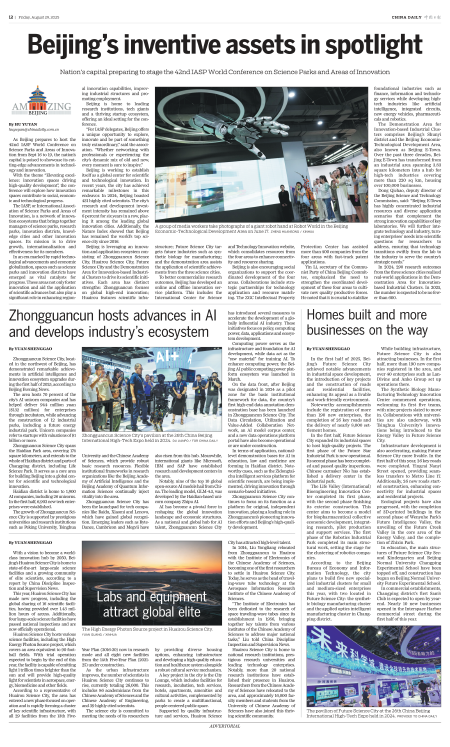


A group of media workers take photographs of a giant robot hand at Robot World in the Beijing Economic-Technological Development Area on June 17.
As Beijing prepares to host the 42nd IASP World Conference on Science Parks and Areas of Innovation from Sept 16 to 19, the nation's capital is poised to showcase its cutting-edge advancements in technology and innovation.
With the theme "Elevating excellence: innovation spaces driving high-quality development", the conference will explore how innovation spaces contribute to social, economic and technological progress.
The IASP, or International Association of Science Parks and Areas of Innovation, is a network of innovation ecosystems that brings together managers of science parks, research parks, innovation districts, knowledge cities and other innovation spaces. Its mission is to drive growth, internationalization and effectiveness for its members.
In an era marked by rapid technological advancements and economic globalization, spaces such as science parks and innovation districts have emerged as vital catalysts for progress. These areas not only foster innovation and aid the application of scientific advances but also play a significant role in enhancing regional innovation capabilities, improving industrial structures and promoting employment.
Beijing is home to leading research institutions, tech giants and a thriving startup ecosystem, offering an ideal setting for the conference.
"For IASP delegates, Beijing offers a unique opportunity to explore, innovate and be part of something truly extraordinary," said the association. "Whether networking with professionals or experiencing the city's dynamic mix of old and new, every moment is sure to inspire."
Beijing is working to establish itself as a global center for scientific and technological innovation. In recent years, the city has achieved remarkable milestones in this endeavor. In 2024, Beijing boasted 431 highly cited scientists. The city's research and development investment intensity has remained above 6 percent for six years in a row, placing it among the leading global innovation cities. Additionally, the Nature Index showed that Beijing has remained the world's top science city since 2016.
Beijing is leveraging an innovation and application ecosystem consisting of Zhongguancun Science City, Huairou Science City, Future Science City and the Demonstration Area for Innovation-based Industrial Clusters to drive its scientific initiatives. Each area has distinct strengths: Zhongguancun focuses on global high-end innovation; Huairou features scientific infrastructure; Future Science City targets future industries such as synthetic biology for manufacturing; and the demonstration area assists the application of scientific achievements from the three science cities.
To better commercialize research outcomes, Beijing has developed an online and offline innovation service platform. This includes the International Center for Science and Technology Innovation website, which consolidates resources from the four areas to enhance connectivity and resource sharing.
Beijing is also encouraging social organizations to support the coordinated development of the four areas. Collaborations include strategic partnerships for technology application and resource matching. The ZGC Intellectual Property Protection Center has assisted more than 400 companies from the four areas with fast-track patent applications.
Yin Li, secretary of the Communist Party of China Beijing Committee, emphasized the need to strengthen the coordinated development of these four areas to cultivate new quality productive forces. He noted that it is crucial to stabilize foundational industries such as finance, information and technology services while developing high-tech industries like artificial intelligence, integrated circuits, new energy vehicles, pharmaceuticals and robotics.
The Demonstration Area for Innovation-based Industrial Clusters comprises Beijing's Shunyi district and the Beijing Economic-Technological Development Area, also known as Beijing E-Town. Over the past three decades, Beijing E-Town has transformed from an industrial area spanning 3.83 square kilometers into a hub for high-tech industries covering more than 220 sq km, housing over 100,000 businesses.
Dong Qichao, deputy director of the Beijing Science and Technology Commission, said: "Beijing E-Town has highly concentrated industrial resources and diverse application scenarios that complement the strong innovation capabilities of key laboratories. We will further integrate technology and industry, turning enterprises' needs into scientific questions for researchers to address, ensuring that technology transitions swiftly from the lab to the industry to serve the country's strategic needs."
In 2024, 290 research outcomes from the three science cities realized real-world applications in the Demonstration Area for Innovation-based Industrial Clusters. In 2025, the number is expected to be no fewer than 600.
huyuyan@chinadaily.com.cn